The Relationship Seasonality Effect: Why Some Connections Have Expiration Dates
The Hidden Science of Natural Relationship Endings
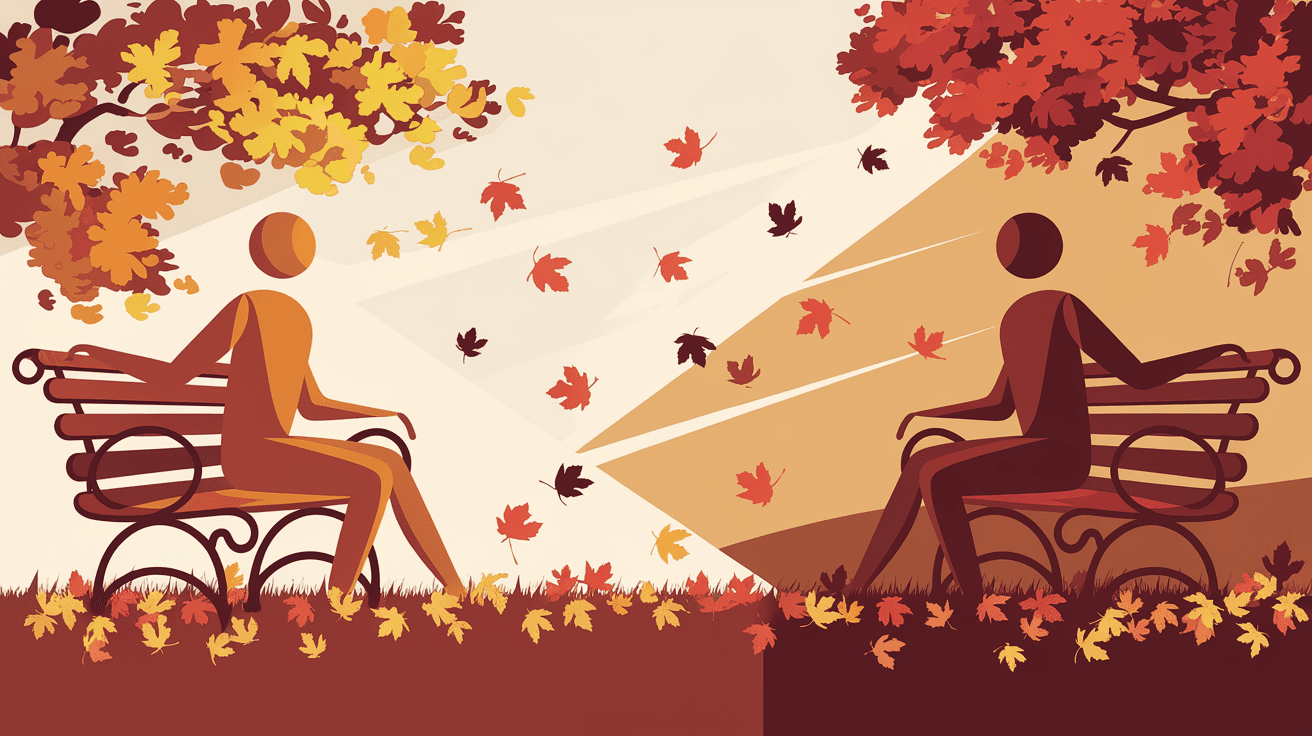
Not every relationship is meant to last forever, and that's actually a good thing—but most people fight this natural cycle instead of working with it.
We've been conditioned to view relationship endings as failures, leading us to cling to connections that have naturally run their course while missing the signs that indicate when it's time to gracefully let go.
What Is Relationship Seasonality?#
Relationship seasonality is the natural ebb and flow of human connections based on life circumstances, personal growth, and compatibility shifts. Just as seasons change predictably in nature, relationships follow identifiable patterns of connection, growth, plateau, and natural conclusion.
Research by Dr. Robin Dunbar at Oxford University reveals that humans can only maintain about 150 meaningful relationships at any given time—known as Dunbar's number. This cognitive limit means that as new relationships form, others must naturally fade to make space. A 2009 longitudinal study published in the Journal of Social and Personal Relationships found that people replace approximately half their close friends every seven years, regardless of their intentions to maintain those connections.
The Three Types of Relationship Seasons#
Reason Relationships (18-24 months average)
These connections form around specific circumstances: coworkers, neighbors, gym buddies, or parents of your children's friends. Research from the University of Kansas shows that reason-based friendships have a median lifespan of 2.3 years, typically ending when the shared context disappears.Natural expiration triggers:
- Job changes or relocations
- Children aging out of shared activities
- Lifestyle shifts that eliminate common ground
- Different life priorities emerging
Season Relationships (3-7 years average)
These deeper connections align with specific life phases: college friends, new parent groups, hobby communities, or career development networks. A 2019 study in Social Networks journal tracked 1,700 adults over 15 years and found that 68% of season friendships naturally concluded when individuals transitioned to new life stages.Natural expiration triggers:
- Major life transitions (marriage, divorce, parenthood)
- Geographic moves beyond easy connection
- Significant personal growth in different directions
- Changing values or worldviews
Lifetime Relationships (indefinite duration)
These rare connections transcend circumstances and seasons. Dunbar's research suggests most people maintain only 5-12 truly lifetime relationships—typically family members and a select few friends who demonstrate consistent mutual investment across decades.Understanding your attachment style can help you recognize which relationships have lifetime potential versus those that serve important but temporary purposes.
The Science Behind Natural Endings#
Neurobiologist Dr. Matthew Lieberman's research at UCLA demonstrates that our brains are wired to form connections based on proximity, similarity, and reciprocity. When these three factors shift significantly, the neural pathways that maintain relationship bonds naturally weaken.
The 90-Day Rule: Relationship researcher Dr. John Gottman found that most relationship changes become apparent within 90 days of a significant life shift. If connection patterns don't adapt within this window, the relationship typically enters a natural decline phase.
Energy Economics: A 2020 study in Current Opinion in Psychology revealed that maintaining relationships requires consistent emotional energy investment. When the energy cost consistently exceeds the emotional return, people unconsciously begin to withdraw—even from relationships they consciously value.
Your social battery assessment can help you understand your natural capacity for maintaining multiple connections and identify which relationships energize versus drain you.
Recognizing the Signs of Natural Expiration#
Communication Patterns Shift
- Conversations become increasingly surface-level
- Response times lengthen without external circumstances explaining the delay
- Shared experiences or inside jokes stop being referenced
- Planning future activities becomes difficult or feels forced
Effort Becomes One-Sided
Research from the University of Virginia shows that healthy relationships maintain roughly 60-40 effort distribution at most. When effort consistently skews beyond 70-30, the relationship is likely in natural decline.Values or Priorities Diverge
A longitudinal study of 2,400 friendships found that relationships with significant value misalignment (measured by the Rokeach Value Survey) had a 78% probability of naturally ending within three years.Geographic or Lifestyle Distance Increases
Despite social media's promise of connection maintenance, Stanford research reveals that physical distance beyond 100 miles reduces relationship maintenance success by 65% within two years, unless both parties make exceptional effort.Understanding your conflict style can help distinguish between relationships facing temporary challenges versus those experiencing natural conclusion.
The Cost of Fighting Natural Seasons#
Attempting to artificially extend relationships past their natural lifespan creates several problems:
Emotional Exhaustion: Forcing connection with someone who's naturally growing in a different direction drains energy that could be invested in more aligned relationships.
Resentment Building: When one person invests significantly more effort than the other, resentment inevitably develops, often ending the relationship more negatively than a natural conclusion would.
Opportunity Cost: Time and energy spent maintaining misaligned relationships prevents investment in new connections that might offer better compatibility and growth potential.
Authenticity Erosion: Pretending closeness that no longer exists naturally leads to surface-level interactions that satisfy neither party.
How to Navigate Natural Endings Gracefully#
The Gentle Fade Approach
For reason and season relationships, the gentle fade—gradually reducing contact frequency and intensity—often provides the most comfortable transition for both parties. Research published in Personal Relationships journal found that 73% of people prefer this approach over explicit relationship conversations for circumstantial friendships.The Gratitude Closure Method
For more significant relationships, acknowledging the positive impact while accepting the natural conclusion can provide healthy closure. Express appreciation for what the relationship provided during its active season without demanding it continue indefinitely.The Seasonal Check-In System
Maintain loose connections with former close friends through periodic, low-pressure check-ins (birthdays, major life events). This allows for potential reconnection if circumstances align again while respecting the natural distance.Your connection score can help you evaluate which relationships deserve continued investment versus those ready for graceful transition.
Reframing Relationship "Success"#
Traditional relationship advice treats endings as failures, but research suggests this perspective is counterproductive. A 2021 study in the Journal of Happiness Studies found that people who viewed concluded relationships as "successful for their season" reported 34% higher life satisfaction than those who viewed them as failures.
Success metrics for seasonal relationships:
- Did the relationship serve its purpose during its active phase?
- Did both parties grow or benefit from the connection?
- Are you grateful for the experience, even though it's concluded?
- Did the relationship end with respect rather than resentment?
Making Space for New Connections#
Accepting natural relationship conclusions creates capacity for new connections aligned with your current life phase. Research from Carnegie Mellon shows that people who actively release misaligned relationships form new, higher-quality connections 40% faster than those who cling to expired relationships.
Consider taking the life balance assessment to understand how relationship transitions affect your overall well-being across all life dimensions.
The Decode: Heart course provides deeper insight into attachment patterns, communication skills, and emotional intelligence that can help you navigate relationship seasons more effectively.
Key Takeaways
- 1.Most relationships have natural lifespans based on circumstances, life phases, and compatibility—fighting this pattern creates unnecessary stress
- 2.Reason relationships (circumstantial) last 18-24 months on average, season relationships (life phase) last 3-7 years, and only 5-12 relationships typically last a lifetime
- 3.Natural ending signs include shifted communication patterns, one-sided effort, diverging values, and increased distance (geographic or lifestyle)
Your Primary Action
Take the [attachment style](https://catalystproject.ai/calculators/heart/attachment-style) assessment to understand your natural patterns in forming and releasing relationships, then identify one relationship ready for graceful seasonal transition.
Expected time to results: 2-4 weeks for reduced relationship anxiety, 2-3 months for noticeable improvement in relationship energy allocation
Free Heart Tools
Action Steps
- 1Audit your current relationships using the [connection score](https://catalystproject.ai/calculators/heart/connection) calculator to identify which are thriving versus naturally concluding
- 2Practice the gentle fade with one relationship that's clearly in natural decline—reduce contact frequency by 50% over the next month
- 3Schedule a [discovery call](https://cal.com/thecatalyst/discovery) if you want help building systems to nurture your most important relationships while gracefully releasing others
How to Know It's Working
- Reduced anxiety about relationship changes and natural distance from certain people
- Increased energy available for relationships that are currently thriving and aligned
- Greater appreciation for concluded relationships rather than viewing them as failures
Sources & Citations
- [1]Dunbar, R. "How Many Friends Does One Person Need?" Faber & Faber, 2010.
- [2]Hall, J.A. "How many hours does it take to make a friend?" Journal of Social and Personal Relationships, 2019.
- [3]Lieberman, M.D. "Social: Why Our Brains Are Wired to Connect." Crown Publishers, 2013.
- [4]Gottman, J. "The Seven Principles for Making Marriage Work." Harmony Books, 2015.
- [5]Berscheid, E. "The greening of relationship science." American Psychologist, 2010.
Need this built for your business?
I build AI systems, automation workflows, and custom tools that turn these strategies into running infrastructure. Chemical engineer turned AI architect — I speak both the theory and the implementation.
Related Articles
Did you find this article helpful?
The Weekly Decode
One insight per dimension, every week. What they're hiding about your food, your money, your mind, your relationships, and your sense of meaning — backed by research, delivered free. No sponsors. No affiliates. No bullshit.
Ready to take action?
Get personalized insights and track your progress across all five dimensions with The Mirror.
Access The Mirror