The Generation Effect: Creating vs Consuming Information
Why Creating Content Beats Consuming for Memory Retention
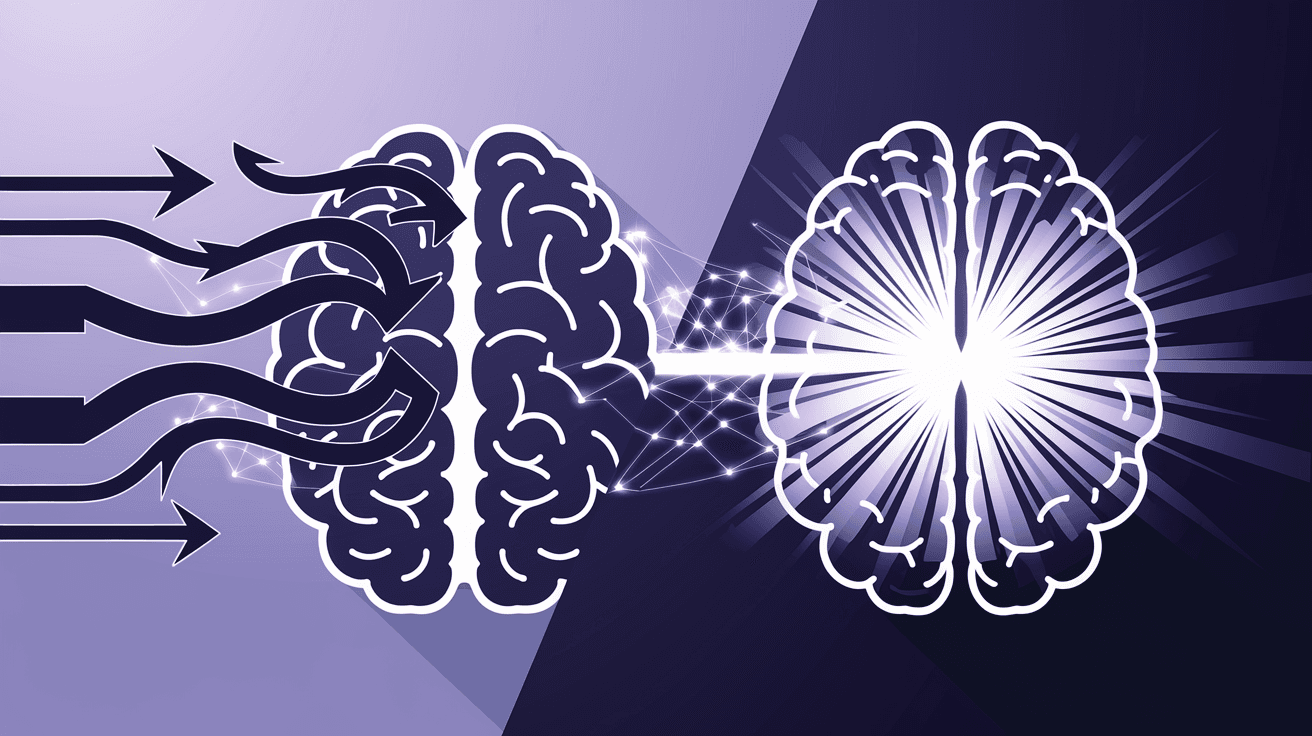
You remember information 3x better when you create it yourself instead of just reading it—which explains why most "learning" is actually forgetting in disguise.
The CREATE Framework: Converting Consumption to Retention#
Most people approach learning backwards. They consume first, hoping knowledge will stick through repetition and review. The CREATE framework reverses this process, transforming you from a passive recipient into an active generator of knowledge.
C - Construct explanations R - Reframe in your own words E - Elaborate with examples A - Apply to new contexts T - Test through teaching E - Extract core principles
Why It Works: The Neuroscience of Generation#
The generation effect isn't just a learning hack—it's how your brain is wired to encode information. When you generate content rather than consume it, three critical processes activate:
Elaborative Processing: Creating forces you to connect new information to existing knowledge networks. A 2019 study by Karpicke and Blunt found that students who generated explanations scored 67% higher on transfer tests compared to those who simply reread material.
Retrieval Practice: Generation requires pulling information from memory rather than recognizing it. This strengthens neural pathways through what researchers call "desirable difficulty"—the brain works harder, creating more durable memories.
Metacognitive Awareness: When you create, you become aware of what you don't know. This metacognitive monitoring is absent in passive consumption, where everything feels familiar and understood until you need to actually use it.
Component 1: Construct Explanations#
Before consuming any information source, commit to explaining it to someone else within 24 hours. This single commitment transforms how you process information.
The Mechanism: When you know you'll need to explain something, your brain automatically shifts from passive recognition to active encoding. You start looking for the core logic, not just the surface details.
Implementation: Choose your explanation target before you start learning:
- A colleague who needs this information
- A journal entry for future reference
- A social media post for your network
- An imaginary conversation with a skeptical friend
Component 2: Reframe in Your Own Words#
Translation kills the illusion of understanding. If you can't explain something in your own words, you don't understand it—you've just memorized someone else's explanation.
The Feynman Test: Can you explain this concept using only common words a child would understand? If not, your understanding is superficial.
Practical Application: After reading any significant piece of information, close the source and write a one-paragraph summary without looking back. This forces your brain to reconstruct the information from memory, revealing gaps in understanding.
A 2020 meta-analysis by Dunlosky and Rawson found that self-explanation improved learning outcomes by an average effect size of 0.61—considered large in educational research.
Component 3: Elaborate with Examples#
Abstract information dies in isolation. Your brain remembers concrete examples and stories far better than principles and theories.
The Example Bridge: For every concept you learn, generate three examples:
- One from your personal experience
- One from a different domain entirely
- One hypothetical scenario where it might apply
Research by Renkl and Atkinson (2003) showed that students who generated their own worked examples performed 34% better on problem-solving tasks than those who studied provided examples.
Component 4: Apply to New Contexts#
Knowledge that can't transfer is trivia. True understanding means recognizing patterns across different situations.
The Transfer Challenge: After learning something new, ask:
- Where else might this principle apply?
- What would happen if I used this in [different context]?
- How does this connect to something I already know?
Studies by Barnett and Ceci (2002) found that students who practiced far transfer—applying concepts to dissimilar contexts—retained information 45% longer than those who only practiced near transfer.
Component 5: Test Through Teaching#
Teaching is the ultimate generation activity. It forces you to anticipate questions, address misconceptions, and organize information coherently.
The Teaching Protocol:
- Identify someone who could benefit from what you've learned
- Prepare a 10-minute explanation without notes
- Deliver it and note where you struggle
- Revisit those struggle points in your source material
- Teach it again
A landmark study by Nestojko et al. (2014) found that students who expected to teach material recalled 28% more information one week later compared to students who expected to be tested.
Component 6: Extract Core Principles#
Surface learning focuses on facts; deep learning extracts transferable principles. The final step of CREATE is distilling specific information into general rules.
The Principle Extraction Process:
- What's the underlying pattern here?
- What rule or principle makes this work?
- Where have I seen this pattern before?
- What would violate this principle?
Application Guide: The 30-Minute Learning Session#
Here's how to apply CREATE to any learning session:
Minutes 1-5: Pre-Generation Setup
- Define what you want to learn
- Choose who you'll explain it to
- Set the context for why this matters
- Read/watch with the intent to teach
- Take notes in your own words
- Pause frequently to check understanding
- Write a summary without looking back
- Generate examples from your experience
- Identify one new application context
- Record the core principle
Example Application: Learning About Compound Interest#
Traditional Approach: Read an article about compound interest, maybe highlight key points, feel like you understand it.
CREATE Approach:
- Construct: "I need to explain to my sister why she should start investing now, not later"
- Reframe: "Money grows faster when you reinvest the growth, like a snowball rolling downhill"
- Elaborate: "My $1000 investment became $1100 after one year, but in year two, I earned interest on $1100, not just $1000"
- Apply: "This same principle works for skill development—small improvements compound over time"
- Test: Actually explain it to your sister and notice where she gets confused
- Extract: "Small advantages compound exponentially when sustained over time"
Common Mistakes to Avoid#
Mistake 1: Generation Without Foundation Creating explanations before you understand the basics leads to confident wrongness. Always ensure you have sufficient input before generating output.
Mistake 2: Perfectionism Paralysis Don't wait until you "fully understand" to start generating. Partial explanations reveal gaps better than complete silence.
Mistake 3: Solo Generation Only Teaching to yourself is better than passive consumption, but teaching to others provides feedback you can't give yourself.
Mistake 4: Surface-Level Examples Generic examples don't stick. The more personal and specific your examples, the stronger your memory traces.
Mistake 5: One-Shot Teaching Teaching once is good; teaching the same concept multiple times to different people is transformative. Each iteration refines your understanding.
Key Takeaways
- 1.The generation effect shows 3x better retention when you create vs. consume information
- 2.Active learning requires flipping from passive recipient to active creator of knowledge
- 3.Teaching forces the deepest level of processing and reveals true understanding gaps
Your Primary Action
Choose one thing you learned recently through passive consumption. Spend 30 minutes applying the CREATE framework to it—starting with explaining it to someone else without looking at your notes.
Expected time to results: 1-2 weeks for noticeable retention improvements, 4-6 weeks for significant memory enhancement
Free Mind Tools
Action Steps
- 1Replace passive reading with the CREATE framework: Construct explanations, Reframe concepts, Elaborate with examples, Apply to contexts, Test through teaching
- 2After consuming any content, immediately write a 2-3 sentence summary in your own words without looking back at the source
- 3Practice teaching concepts to others or explaining them aloud to activate retrieval practice and identify knowledge gaps
- 4Create examples and applications for new information within 24 hours of learning it to strengthen neural pathways
How to Know It's Working
- Ability to explain concepts without referring to original sources after 1 week
- Improved performance on practice tests or real-world application of learned material
- Reduced time needed for review sessions while maintaining comprehension levels
Need this built for your business?
I build AI systems, automation workflows, and custom tools that turn these strategies into running infrastructure. Chemical engineer turned AI architect — I speak both the theory and the implementation.
Related Articles
Did you find this article helpful?
The Weekly Decode
One insight per dimension, every week. What they're hiding about your food, your money, your mind, your relationships, and your sense of meaning — backed by research, delivered free. No sponsors. No affiliates. No bullshit.
Ready to take action?
Get personalized insights and track your progress across all five dimensions with The Mirror.
Access The Mirror